How We Automates Businesses
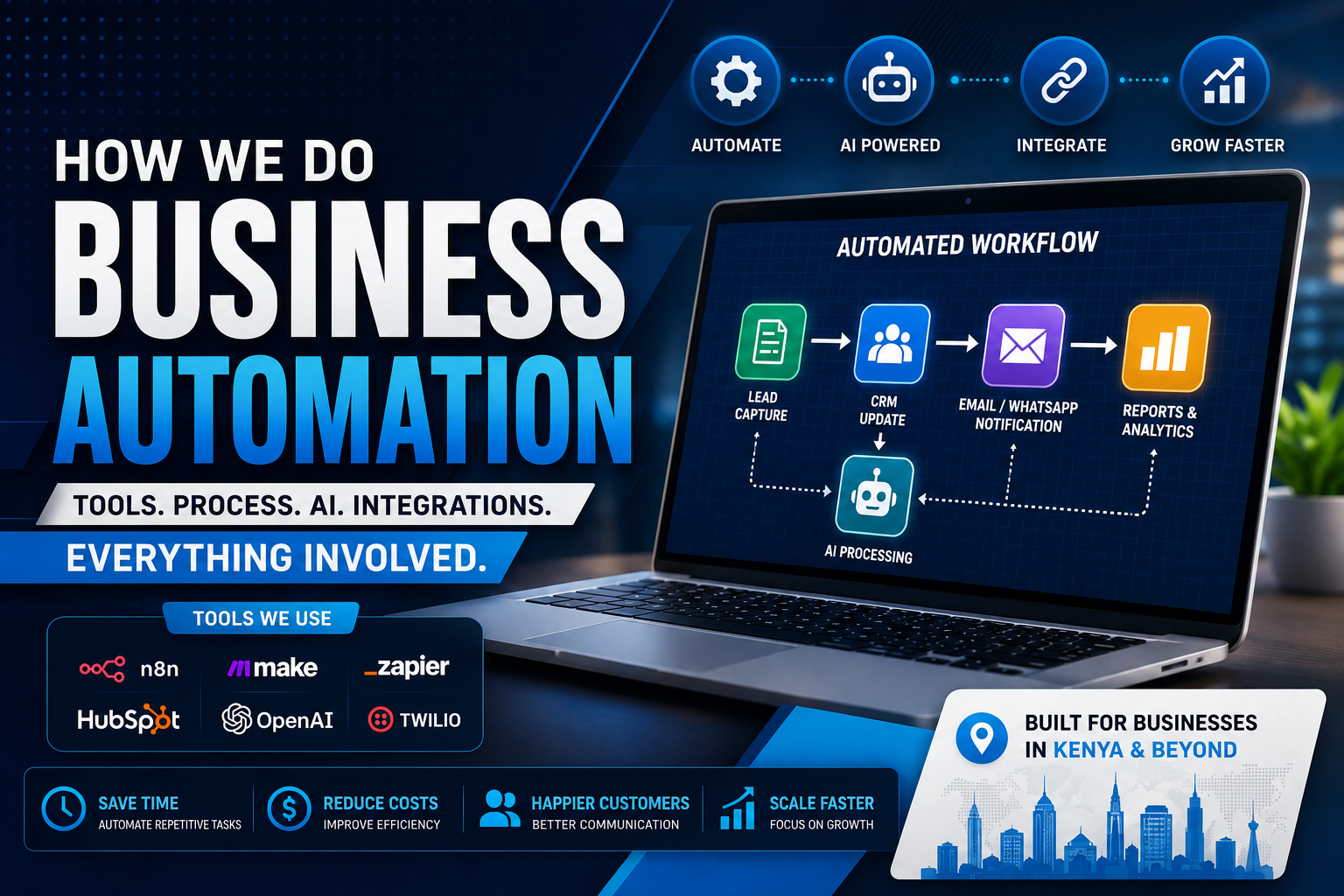
How We Build Business Automation Systems at digidwel.com
Business automation is no longer a luxury. In 2026, businesses that still rely entirely on manual work are losing time, money, and opportunities.
At Digidwel Technologies, we help businesses automate repetitive operations, improve customer communication, streamline workflows, and increase efficiency using modern software, AI, and cloud tools.
Whether it’s a small business in Kenya, an eCommerce store, a service company, or a growing startup, automation can transform how the business operates.
In this article, we’ll break down:
The tools we use
Our automation process
How AI is involved
APIs and integrations
Real-world business use cases
Security and maintenance
Why automation matters for African businesses
What Is Business Automation?
Business automation is the process of using technology to handle repetitive tasks with minimal human involvement.
Instead of manually:
Sending invoices
Replying to customer messages
Tracking leads
Updating spreadsheets
Following up clients
Managing appointments
Posting content
Automation systems perform these tasks automatically.
This allows businesses to:
Save time
Reduce human error
Improve customer experience
Scale operations faster
Focus on growth instead of repetitive work
The Main Areas We Automate
At Digidwel Technologies, we automate several
business operations including:
1. Customer Communication
We automate:
WhatsApp replies
Email sequences
SMS notifications
AI customer support chatbots
Appointment reminders
Tools We Use
2. Sales & Lead Automation
Businesses lose many customers because leads are not followed up quickly.
We build systems that:
Capture leads automatically
Store customer information
Trigger follow-up emails
Notify sales teams instantly
Track conversion performance
CRM & Automation Tools
zoho.com�
3. AI-Powered Automation
Artificial Intelligence is changing automation completely.
We integrate AI systems that can:
Answer customer questions
Generate reports
Analyze customer behavior
Create content
Recommend products
Summarize conversations
Process documents
AI Tools & Models We Work With
n8n.io� AI agents
Custom Python AI workflows
Our Automation Development Stack
At Digidwel Technologies, we combine multiple technologies depending on business needs.
Frontend Technologies
These are used to build dashboards and user interfaces:
Next.js
React
Tailwind CSS
TypeScript
Backend Technologies
These power the logic and automation systems:
Django
Django REST Framework
Node.js
Python automation scripts
Databases
We use scalable databases to store business data:
PostgreSQL
MongoDB
MySQL
Automation Platforms
These connect services together:
n8n.io�
APIs: The Backbone of Automation
APIs allow different systems to communicate with each other.
For example:
A customer fills a form on a website
The data goes to a CRM
A WhatsApp message is sent automatically
The sales team receives a notification
The lead is stored in a database
All this happens within seconds through APIs.
APIs We Commonly Integrate
Payment APIs
WhatsApp APIs
Email APIs
SMS APIs
Maps & location APIs
eCommerce APIs
AI APIs
Analytics APIs
Payment Integrations
In Kenya, mobile payments are critical.
We integrate:
Stripe
PayPal
Our Automation Process
Step 1: Business Analysis
We first analyze:
Current workflow
Bottlenecks
Repetitive tasks
Customer journey
Existing tools
The goal is identifying where time and money are being lost.
Step 2: Workflow Mapping
We design the workflow architecture:
Trigger points
Actions
Conditions
Notifications
Integrations
Database flow
This acts like the blueprint of the automation system.
Step 3: System Development
This stage involves:
Backend development
API integration
Dashboard creation
AI integration
Database setup
Authentication & security
Step 4: Testing & Optimization
We test:
Speed
Reliability
API responses
Error handling
Security vulnerabilities
User experience
Automation must be reliable before deployment.
Step 5: Deployment & Monitoring
After deployment we:
Monitor performance
Track automation failures
Improve workflows
Update integrations
Scale infrastructure
Automation is never “set and forget.”
Real Examples of Business Automation
eCommerce Stores
We automate:
Order confirmations
Inventory updates
Customer support
Cart recovery emails
Product recommendations
Real Estate Platforms
Automation helps:
Match buyers with houses
Notify users of new listings
Schedule property visits
Generate invoices
Track leads automatically
Clinics & Health Businesses
We can automate:
Appointment scheduling
Patient reminders
Health tracking dashboards
Payment confirmations
Medical report management
Schools & Training Institutions
Automation can handle:
Student registration
Fee tracking
Notifications
Attendance systems
Online learning workflows
Security in Automation Systems
Security is extremely important.
At Digidwel Technologies, we implement:
JWT authentication
Secure API handling
Encrypted databases
Role-based access
Cloud backups
HTTPS security
Rate limiting
Monitoring systems
A poorly secured automation system can expose sensitive business data.
Why Automation Matters
Many businesses still operate manually:
Paper records
Manual communication
Spreadsheet dependency
Delayed follow-ups
Automation helps businesses become:
Faster
More competitive
More scalable
More professional
With growing internet access and mobile payments in Africa, automation is becoming essential.
The Future of Automation
The future is moving toward:
AI agents
Autonomous workflows
Voice AI assistants
Predictive analytics
Smart recommendation systems
Fully automated customer service
Businesses that adapt early will have a major advantage.
Final Thoughts
At digidwel.com�, we believe automation should not replace people it should remove repetitive work so businesses can focus on growth, creativity, and decision-making.
From AI-powered systems to custom APIs and automation workflows, we help businesses build modern digital operations that scale.
If your business still relies heavily on manual processes, now is the time to automate.
Contact Digidwel Technologies
🌐 Website: digidwel.com�
📱 Call/WhatsApp: +254750468852